

Tracking Options in MyACB: How Calls and Puts Affect ACB
How calls, puts, exercises, and assignments affect your adjusted cost base in Canada, and how MyACB now tracks options manually or by brokerage import.
By popular demand, options are now supported in MyACB. You can track listed calls and puts on the same ledger as the shares they’re written on, and MyACB continues to work out the gains, losses, and ACB adjustments for you. Enter them manually, or import them automatically from supported brokerages.
Tracking options is where a lot of spreadsheets fall apart. A stock trade only does one thing to your ACB. An option can create a gain in one year, cancel it the next, and quietly change the cost of shares you buy or sell along the way. Keeping that straight by hand is tedious, and it’s easy to get wrong.
How Options Affect Your ACB in Canada
In Canada, options held on capital account follow the capital gains rules. Buying an option isn’t taxable until it’s sold, expires, or is exercised. Writing an option is a capital gain right away. When an option is exercised or assigned, its cost or premium moves into the share trade instead of being taxed on its own.
The tax result depends on whether you bought the option or wrote (sold) it, and on how the position ended. Here’s how MyACB treats each event for options held on capital account:
| Position | Event | Tax result |
|---|---|---|
| Bought | Buy a call or put | No gain or loss. The premium plus commission is the option's ACB. |
| Bought | Sell it to close | Capital gain or loss: proceeds minus commission minus ACB |
| Bought | It expires | Capital loss equal to its ACB, in the year it expires |
| Bought | You exercise a call | No gain or loss on the option. Its ACB is added to the cost of the shares you buy. |
| Bought | You exercise a put | No gain or loss on the option. Its ACB is deducted from the proceeds of the shares you sell. |
| Written | Write a call or put | Capital gain equal to the premium minus commission, in the year you write it |
| Written | Buy it back | The original gain stays. The buy-back cost is a capital loss in the year you buy back. |
| Written | It expires | Nothing new. The original gain stays. |
| Written | A call is assigned | The original gain is cancelled. The premium is added to the proceeds of the shares you sell. |
| Written | A put is assigned | The original gain is cancelled. The premium is deducted from the cost of the shares you buy. |
Identical options you hold (same underlying, type, strike, expiry, and contract terms) are averaged together, just like shares.
Two of these catch people off guard.
Writing an option is a gain right away
When you write an option, the premium is a capital gain in the year you write it, even though the position is still open. It isn’t deferred until the option closes. If you write a call in December and it expires in February, the gain belongs to December’s tax year.
Assignment can reach back into a filed return
If a written option is assigned, the original gain is cancelled and the premium moves into the share trade instead. When the write and the assignment fall in different tax years, that means a year you may have already filed.
Say you own 100 shares of XYZ with an ACB of $4,000.
- December 5, 2025. You write one XYZ $50 call for a $300 premium and pay $10 in commission. That’s a $290 capital gain for 2025.
- January 16, 2026. The call is assigned, and you sell your 100 shares at $50 for $5,000.
The assignment cancels the 2025 gain. Instead, the $300 premium is added to the share proceeds and the $10 commission is deducted:
| Share proceeds (100 × $50) | $5,000 |
| Plus option premium | $300 |
| Less option commission | $10 |
| Adjusted proceeds | $5,290 |
| Less ACB | $4,000 |
| Capital gain (2026) | $1,290 |
You report the full $1,290 in 2026 and nothing in 2025. If you already filed 2025 with the $290 gain on it, subsection 49(4) of the Income Tax Act lets you amend that return, as long as you do it by your 2026 filing due date (April 30, 2027 for most people, or June 15, 2027 if you or your spouse or common-law partner have self-employment income).
Calls and superficial losses
Buying a call is treated as acquiring a right to the shares. So if you sell shares at a loss, buy a call on the same stock within 30 days before or after, and still hold it 30 days after the sale, the superficial loss rule can apply. MyACB warns you when a call purchase falls in that window.
Capital or income?
MyACB reports options on capital account. For calls and puts you buy, and for calls written against shares you own, that usually follows how you treat the shares. Naked written options are a different story. CRA’s long-standing position (archived Interpretation Bulletin IT-479R) is that they’re generally income unless you report them as capital consistently. By CRA’s definition, an option is only covered if you own the underlying shares, so a cash-secured put still counts as naked. MyACB doesn’t make that call for you, and Tax Prep includes a reminder.
Entering Options Manually
When you add a transaction, choose Option instead of Stock / ETF, then pick the underlying security. Options live on the same ledger as their shares, so an XYZ call shows up right alongside your XYZ buys and sells.
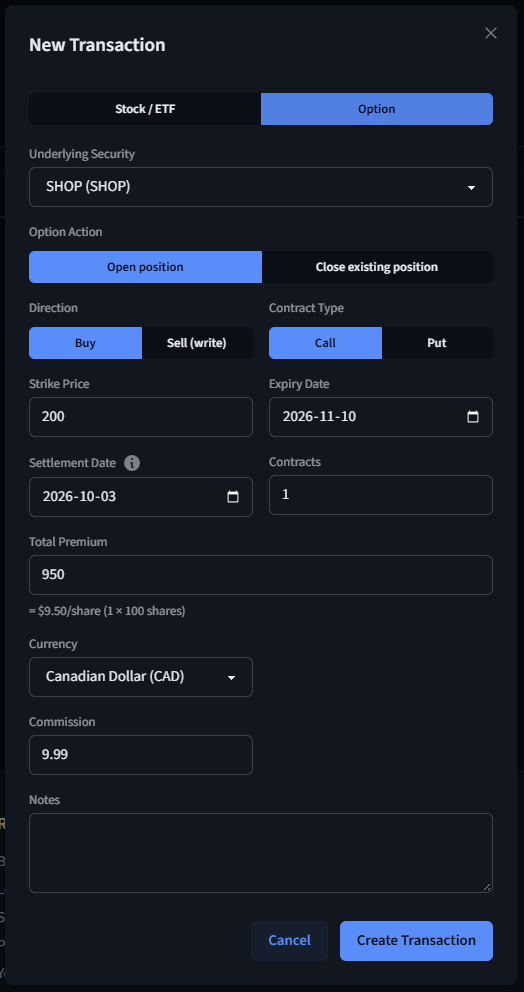
To open a position, choose Open position, then:
- Direction: Buy, or Sell (write)
- Contract Type: Call or Put
- Strike Price and Expiry Date
- Settlement Date: when the trade settled (why settlement date)
- Contracts: how many contracts
- Total Premium: what you paid or received for all of them. MyACB shows the per-share price underneath so you can check it against your trade confirmation.
- Currency and Commission
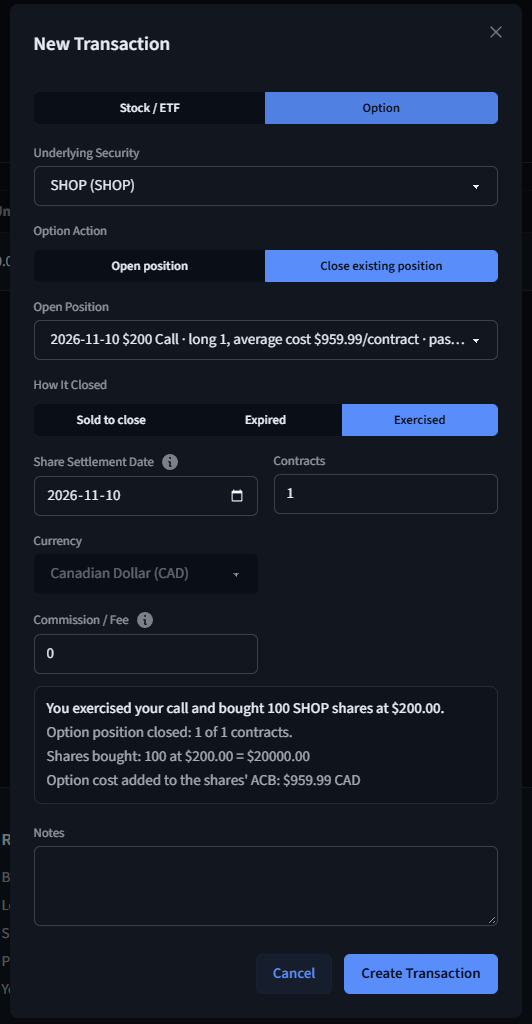
To close a position, choose Close existing position and select it from your open positions. MyACB fills in the contract details and asks how it closed: sold or bought to close, expired, exercised, or assigned. Partial closes work too.
Exercises and assignments create the share trade for you. Exercise a call and MyACB adds the share buy at the strike price, with the option’s cost already included in the ACB. You’ll see a preview of the share side before you save.
MyACB never assumes an option expired. If a contract is still open after its expiry date, it shows up in your items requiring review on the transactions page and in Tax Prep, so you can record what happened.
Importing Options
Don’t want to add options by hand? Me neither! That’s why MyACB Brokerage Import reads option activity from popular brokerages like Wealthsimple, Interactive Brokers, Questrade and more. Trades, expiries, exercises, and assignments are imported along with your stock trades. When an exercise or assignment shows up as separate option and share rows, MyACB pairs them so the premium ends up in the share’s ACB.
If your file starts partway through a position, for example a call you bought before the earliest date in the export, MyACB can’t close something it never saw open. Those rows are skipped and listed in the preview, so you can add the opening by hand and keep going.
Tax Prep
Option gains and losses get their own section on the Tax Prep page. On Schedule 3, options don’t go with shares. CRA’s guide (T4037) lists options as “other properties”, reported on the line for bonds, debentures, promissory notes, and other similar properties. MyACB totals them separately so they land on the right line. Shares you bought or sold through an exercise or assignment stay with your other share dispositions, with the option premium already included.
If an assignment cancelled a gain from an earlier year, like the XYZ example above, Tax Prep tells you which year was affected and the deadline to amend it.
Pricing
You can enter options manually on any plan, including Free, and the MyACB CSV import handles them too. Importing options straight from your brokerage’s export is part of the Household plan. On the Free plan, brokerage files still import your stock trades as usual, and the option rows are skipped.
Frequently Asked Questions
Is the premium from writing an option taxable in Canada?
Yes. On capital account, the premium minus commission is a capital gain in the year you write the option, even if the position is still open at year end.
What happens to my capital gain if a written option is assigned?
The gain from writing the option is cancelled. For a call, the premium is added to the proceeds of the shares you sell. For a put, it’s deducted from the cost of the shares you buy. If you already filed the year you wrote the option, you can amend it under subsection 49(4) of the Income Tax Act by the filing due date for the year of the assignment.
Is an expired option a capital loss?
If you bought it, yes. The option’s ACB is a capital loss in the year it expires, and the superficial loss rule doesn’t apply to an expiry. If you wrote it, nothing new happens. The gain you reported when you wrote it stands.
Where do option gains go on Schedule 3?
Option gains and losses go on the line for bonds, debentures, promissory notes, and other similar properties, not the line for shares. Shares bought or sold through an exercise or assignment are reported with your other share dispositions.
Can buying a call trigger the superficial loss rule?
It can. A call is a right to acquire the shares, so if you sell shares at a loss and buy a call on the same stock within 30 days before or after, and still hold it 30 days after the sale, the loss may be denied.
This article is for informational purposes only and does not constitute tax, legal, or financial advice. Tax rules can change and individual circumstances vary. Consult a qualified tax professional for advice specific to your situation.
0 Comments
Log in to join the discussion.
No comments yet. Be the first to comment!